The Trope Problem: When Damage Is Just Flavor Text
Pick up any thriller published in the last twenty years and there's a decent chance the protagonist drinks too much. He — it's usually he — stares at an empty glass, makes a self-aware comment about his problem, then does something extraordinary before the chapter ends. The drinking is decoration. It signals depth without creating it. It says: this man has been through things without ever demonstrating what those things actually did to him.
This is the broken hero as aesthetic choice. It's the craft shortcut that has infected the genre for decades. Give the operative a vice, give him a moment of self-reflection, and move on. The drinking never costs him anything structurally. The trauma never interrupts the plot at an inconvenient moment. The damage is managed, contained, narratively safe.
Readers in this genre know the difference. They've read enough Mitch Rapp, enough Jack Reacher, enough Jack Ryan variants to understand when an author has actually thought through what damage does to a person — and when they've just attached the signifiers to an otherwise functional superhero.
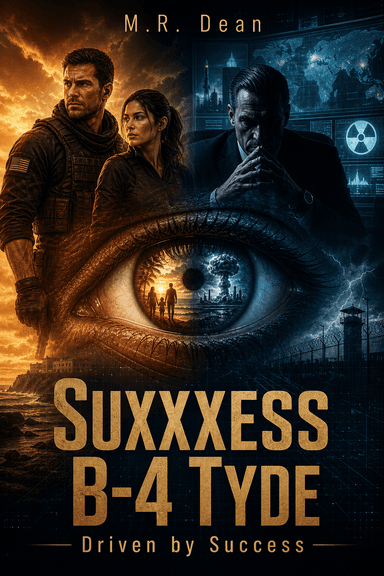
M.R. Dean thought it through.
Perry Wade's Specific Damage and Why It Matters
Perry Wade is not a man who drinks because it's what his archetype requires. He drinks because of Vvee. Because of what his career cost him in terms of the life he wanted. Because of what it means to be the best at something that can never be publicly acknowledged — to save the world in rooms that don't officially exist, and then come home to a house that doesn't feel like one.
The specificity of the damage matters enormously. When Perry says, "I have a twenty-year-old heart problem that I can't seem to fix," he's not talking about cardiology. He's naming the weight he has carried since the relationship with Veronica Valdez became collateral damage of his career. Twenty years. Not "a long time." Not "years." Twenty years. The precision of that number tells you that Perry has counted every one of them.
That kind of specificity can only come from an author who has built the damage from the inside out — who decided first what broke this man, and then worked forward to show what that breaking looks like in behavior, in posture, in the way he speaks to the one person who might understand.
Addiction as a Plot Engine, Not a Subplot
The worst use of addiction in genre fiction is the subplot. The hero's drinking is a B-story that gets resolved in a single scene — usually through a confrontation from a loved one, or a moment of near-failure that convinces him to be better. Then the A-story continues and the addiction is effectively solved.
Suxxxess b-4 Tyde doesn't do that. Perry's alcoholism is structural. It is the reason he is on medical leave when the story begins. It is the reason there's a question about whether he can even be brought back for the operation. It is the condition that Vvee — who is herself a federal agent, not a civilian — has to account for as both a professional partner and a person who has never fully let him go.
When addiction is a plot engine, it creates real problems at inconvenient moments. It raises the question — never fully answerable — of whether Perry's judgment can be trusted. Not just in combat, or in the field, but in the moments that matter most: reading a situation, making a call, deciding who to trust.
Vick Tyde is running a global operation from a federal prison cell. His intelligence on Perry likely includes Perry's condition. Part of what makes Tyde terrifying is that he thinks architecturally — he identifies structural weaknesses and builds toward them. Perry's addiction is a structural weakness. It is not separate from the stakes of the novel. It is part of the threat architecture.
What PTSD Looks Like in Fiction That Gets It Right
Post-traumatic stress in fiction has a presentation problem. In film, it's usually a specific trigger — a sound, a visual — that drops the character into a flashback. The mechanism is shown once, acknowledged, and then managed. The character grows past it, or learns to live with it, and the story moves on.
Real PTSD doesn't work on a narrative schedule. It surfaces when it's least welcome. It reorganizes how a person processes information, how they read threats, how they experience relationships. It is not a flashback sequence — it's a rewiring.
The way Perry's trauma manifests in Suxxxess b-4 Tyde is less about dramatic episodes and more about the chronic weight. The medical leave. The isolation. The drinking that is itself a symptom — a way of managing an internal state that doesn't respond to the coping mechanisms available to ordinary people. Perry can't talk to a therapist who has the clearance to understand what he's actually processing. He can't explain to anyone outside the classified world what it meant to do what he did for the years he did it.
The isolation of the classified operator is one of the most psychologically corrosive aspects of that career, and Dean builds it in. Perry's damage is, in part, the damage of being unable to be known — of living a life that cannot be discussed, celebrated, processed, or grieved in public.
The Return: Why Coming Back Is the Hardest Scene
In the broken hero arc, the return to action is often written as triumphant. The hero gets the call, straightens up, and is immediately operational again. The transition from broken to functional takes approximately one scene.
Perry Wade's return is complicated. It is not a snapping-to. It's a negotiation — with the government that needs him, with Vvee who knows exactly what she's asking when she's part of the team that brings him back in, and with himself. The question that runs underneath the early chapters of the operation is not whether Perry can do this physically. It's whether he can do it without fracturing.
That question is what elevates Perry above most thriller protagonists in this genre. The reader genuinely doesn't know whether he'll hold together. That uncertainty is not decorative. It is the engine of the character's sections of the novel.
Comparing Perry Wade to Other Government Operatives in Fiction
The template in American political thriller fiction for the Black operative has been, historically, limited. The Alex Cross model — forensic psychologist, procedural detective work, family stakes — is the dominant commercial version. Vince Flynn's Mitch Rapp is effective but unapologetically a vehicle for a particular political worldview. Jason Bourne is the operative-as-weapon, a man whose damage is literalized as amnesia.
Perry Wade is different from all of them. He's not a detective. He's not a political instrument. He's not amnesiac. He knows exactly who he is, exactly what he did, and exactly what it cost. The cost is the story.
The closest analog in television is Michael Corvin from certain arcs of Power — a man of exceptional capability who is also genuinely damaged by the life he chose, and who cannot separate the damage from the capability because they come from the same source. But Perry's context is geopolitical rather than street-level, which gives the stakes a different scale.
"I hope God does have something big planned because what I'm up against feels like Armageddon." (Ch. 58)
That's not a man who has healed. That's a man who has decided that what's left of him is enough — and is praying he's right.
What the Broken Hero Owes the Reader
The reader of genre fiction makes a contract with a protagonist. They will spend hours inside this person's head. They will track the character's decisions, feel the weight of their choices, invest in whether they survive and whether they succeed.
When an author puts damage into a protagonist — alcoholism, PTSD, a twenty-year grief that has never resolved — they take on an obligation. The damage has to matter. It has to complicate things, cost things, make things harder in ways that a undamaged version of the character would not experience. And it has to be treated with enough honesty that the reader who has actually lived with addiction, or grief, or trauma, recognizes it.
M.R. Dean meets that obligation. Perry Wade's broken pieces are not furniture. They are structural — the load-bearing elements of a character who, by the final chapter, you understand completely, even if you can't quite predict what he'll do next.
How Perry Wade's Damage Works vs. the Genre Default
| Damage element | Typical thriller use | How Suxxxess b-4 Tyde uses it |
|---|---|---|
| Alcoholism | Decorative — signals depth, costs nothing structurally | Structural — the reason Perry is on medical leave when the story begins |
| Trauma origin | Vague backstory ("been through things") | Specific — the loss of Vvee, counted to the year ("twenty years") |
| Return to action | One scene; hero snaps back to full capability | A negotiation — with the government, with Vvee, with himself |
| PTSD presentation | Single trigger sequence; managed and moved past | Chronic weight — isolation, medical leave, drinking as a symptom |
| Villain's awareness of it | Ignored | Tyde thinks architecturally; Perry's addiction is a named weakness in the threat calculus |
Buy on Amazon — or read Chapter 1 free at /the-book#chapter-1.