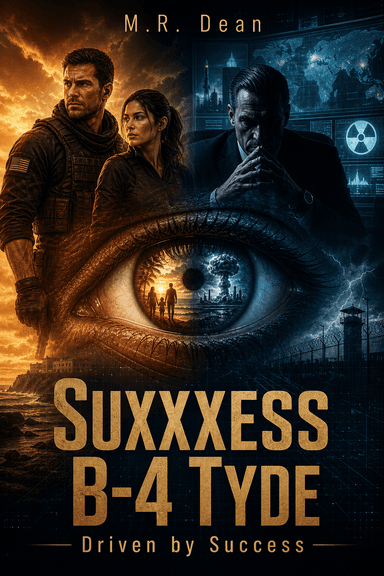
The Cliché: The Agent With a Woman to Save
The default structure is familiar enough to be tiresome. Male operative. Female love interest. She gets taken. He goes to war to retrieve her. Their reunion is the emotional payoff the thriller has been building toward.
The woman exists, in this construction, as a function of the male protagonist's motivation. Her value is instrumental: she gives him a reason to escalate, to take risks he might not otherwise take, to access a register of emotion the action sequences don't otherwise provide. She is the reason. She is not the character.
The irony is that this structure often produces the weakest version of both the relationship and the thriller. When the female character is primarily a plot device, readers who notice this — and a lot of them do, particularly women readers who represent a substantial portion of the thriller market — disengage. The relationship doesn't land because it was never built. It was installed.
Suxxxess b-4 Tyde operates differently.
Why Vvee Is Not That
Veronica "Vvee" Valdez is a federal agent. Not a love interest who happens to have adjacent-to-federal-agent skills. An actual federal agent, with a career, with professional standing, with the specific kind of capability that puts her on the same operational mission as Perry.
This is the structural choice that changes everything. When Vvee is in the field in Suxxxess b-4 Tyde, she is not there because of her relationship to Perry. She's there because she is qualified. The relationship and the professional context exist simultaneously, and neither one diminishes the other.
The kidnapping — when Sid, Tyde's brother, takes Vvee — is not the moment Vvee stops being a character and becomes a plot device. It is the moment that reveals how much the threat architecture has evolved, how personal Tyde is willing to make this, how thoroughly he has mapped Perry's vulnerabilities. Vvee being taken is a tactical event in the plot logic of the villain, not just an emotional beat for the hero.
That distinction matters. It keeps Vvee in the story as an agent — even when she's been removed from the field — rather than reducing her to a symbol of what Perry is fighting for.
History as Character Weight: Childhood Sweethearts
The most valuable thing the Russellville origin gives this relationship is time. Perry and Vvee knew each other before either of them was the person they became. They knew each other when the world was still something that happened to other people, before the government made specific claims on both of their lives.
That kind of history is irreplaceable in fiction because it creates a register of knowledge between two characters that no adult relationship can replicate. Vvee knows things about Perry that are pre-classified. She knew him when he was just a person — not an operative, not a legend, not a man on medical leave drinking his way through whatever happened to him in the classified world.
This is why the nickname "Fancy Face" lands with weight. It's not a cute detail. It's evidence of a relationship that predates everything that came between them — a language they developed in Russellville that still operates underneath all the federal agency protocols and operational security and years of distance.
Childhood sweetheart stories in adult fiction work when the author is willing to honor the fact that the past is not gone. It is present in every interaction, shaping how two people read each other, what they expect, what they've been bracing against for decades. Dean honors that.
Two Federal Agents, One Mission, One Unresolved Decade
There is a specific kind of tension that happens when two people who have unresolved history are forced into professional proximity. It is different from ordinary romantic tension because neither party can fully address what's between them — the mission structure won't permit it.
On the cruise ship, Perry and Vvee are running an undercover intelligence operation against a Russian arms dealer. Their covers, their professional coordination, their physical proximity in an enclosed environment — all of it creates pressure on the relationship that neither of them has space to process. The operation is the container that makes everything that has been unresolved for a decade impossible to ignore and impossible to address directly.
This is great thriller structure. The plot isn't just advancing; it's creating the precise conditions under which the emotional stakes are highest. The reader doesn't experience the mission and the relationship as separate concerns. They are the same concern. What happens between Perry and Vvee on that ship is not a distraction from the thriller plot. It is part of the thriller plot.
"I Have a Twenty-Year Heart Problem I Can't Fix" — Unpacking That Line
"I have a twenty-year-old heart problem that I can't seem to fix." (Ch. 58)
This line does what the best single lines in fiction do: it contains the entire emotional architecture of the story in a sentence small enough to fit in a text message.
Twenty years. The relationship broke — or was interrupted, or was sacrificed — roughly twenty years before the events of the novel. Perry has been measuring the time. He hasn't been counting because he's obsessive; he's been counting because it's the clock he's been unable to stop.
"Heart problem" works on multiple levels simultaneously. It's the literal truth — whatever it was that happened between Perry and Vvee left a wound that has not healed. It's also a wry displacement: the spy who can calculate tactical risk to the decimal point, who has assessed threats that would destabilize governments, cannot figure out how to fix something as apparently simple as a relationship with a woman he loves.
The inability to fix it is not about emotional unavailability. It's about the specific impossibility of bridging the gap between his classified life and any sustained intimacy. He cannot bring Vvee fully into what he does. She is in the world — she's a federal agent, she understands more than most — but there is a ceiling. And he has been living beneath that ceiling for twenty years.
What Real Love Looks Like in Fiction Built for Adults
Adult readers — readers who have had twenty-year relationships, who have let things go unresolved across decades, who know what it means to still carry something you've given up on fixing — recognize something different in this.
The love story in Suxxxess b-4 Tyde is not aspirational in the way that genre romance is aspirational. It doesn't offer the comfort of certain resolution. It offers something more honest: the portrait of two people who have real, specific, durable feelings for each other, who are also professional agents of the federal government, who also have Vick Tyde trying to destroy the world from a prison cell in South Dakota, who also have Crimson and Little Perry — Vvee's children — in the picture, who also have a mission that cannot wait for the relationship to be figured out.
"You were always somebody. You assisted me in saving the world." (Vvee to Perry)
That line is the culmination of something. It's not romantic in the conventional sense — it doesn't declare love directly. It does something more powerful: it tells Perry that the cost was seen. That what he sacrificed, what his career required of him, what the classified world took and kept — she sees the shape of it, even from the outside. She's telling him that his life, the life that never quite came together the way it should have, mattered.
For a man who has spent decades in a world that can never acknowledge him publicly, that may be the only kind of recognition that counts.
When the Love Story Works: What Perry and Vvee Do Differently
| Element | The cliché | Perry and Vvee in Suxxxess b-4 Tyde |
|---|---|---|
| Her role | Love interest installed as motivation | Veronica "Vvee" Valdez is a working federal agent on the same mission |
| Origin | Romance begins inside the thriller's world | Childhood sweethearts from Russellville — predates the classified world |
| Kidnapping | Removes her from the story; makes her a symbol | Reveals how far Tyde has mapped Perry's vulnerabilities; keeps her in the plot logic |
| Shared pressure | Relationship scenes pause the mission | An undercover cruise-ship op puts unresolved history under direct mission pressure |
| Defining line | A declaration of love | "I have a twenty-year-old heart problem that I can't seem to fix." (Ch. 58) |
Buy on Amazon — or read Chapter 1 free at /the-book#chapter-1.