The Cliché: The Drinking Detective
The alcoholic investigator is so thoroughly embedded in detective and thriller fiction that it has become essentially invisible. Philip Marlowe drank. Sam Spade drank. Every procedural from The Wire to True Detective has at least one character whose relationship with alcohol is doing double duty as both character flaw and atmospheric detail.
The problem with the cliché is not that it's unrealistic. Addiction at high rates in high-stress, high-stakes professions is well-documented. The problem is that in most fiction, the drinking doesn't actually do anything. It's present in the character description, it surfaces in a scene or two where the character makes a choice that's slightly worse than sober, and then it's managed — set aside for the action sequences, bracketed out of the moments where the character needs to be functional.
The cliché gives you the signifier without the consequence. The reader gets to feel like this is a damaged, complicated character without having to actually reckon with what addiction does to a person's capacity to operate.
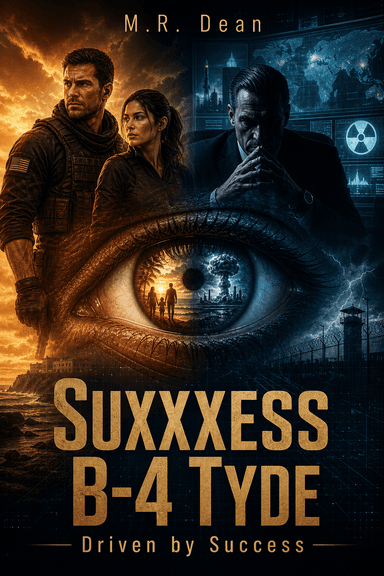
Suxxxess b-4 Tyde doesn't give you the signifier. It gives you the thing itself.
What Makes Perry Wade's Alcoholism Different
Perry Wade is on medical leave when the novel begins. The medical leave is real. It's not a cover, not a staging position, not a temporary break from field work while he waits for his next assignment. He is genuinely unfit for service in his current condition, and the government — which needs him badly enough to pull him back in — is making a calculated bet that he can hold together for long enough to be useful.
That's a different framing than most thriller protagonists with drinking problems receive. There's no winking at the audience about how the hero will be fine once things get serious. The institutions that know Perry best are uncertain about whether he can do this. That uncertainty is introduced in the early chapters and never fully resolved.
The practical consequence of this framing: every scene where Perry is operational carries a question the reader can't dismiss. Not whether Perry has the skills — he clearly does — but whether the skills are accessible right now, in this moment, with this much at stake. That question is what converts the alcoholism from character detail to structural force.
PTSD and Substance Use: What the Research Says
The co-occurrence of post-traumatic stress disorder and alcohol use disorder is one of the most robustly documented findings in clinical literature on trauma. Rates of hazardous drinking are substantially elevated in populations with PTSD — veterans, first responders, survivors of prolonged high-threat exposure. The relationship is partly neurobiological: alcohol temporarily dampens the hyperarousal state that characterizes PTSD, producing short-term relief that reinforces the behavior pattern.
The difficulty for the person living with this combination is that alcohol also disrupts sleep architecture, increases emotional dysregulation, and over time exacerbates the very symptoms it temporarily relieves. It's a loop. The thing that makes the night bearable makes the condition worse by morning.
For Perry Wade, whose career has involved years of classified operations in high-threat environments, and whose emotional landscape includes a twenty-year grief that has never been processed in anything like a normal way, the alcohol is not a character flaw in the moral sense. It's a coping mechanism for a psychological load that would be extraordinary under any circumstances — and that he has been carrying largely alone, in a classified context where he cannot fully disclose the nature of what he's processing.
Dean doesn't lecture about any of this. It's embedded in the behavior, in the structure of the medical leave, in the way the people around Perry assess his reliability. The clinical reality is present in the fiction without the fiction becoming clinical.
The Government Operative Who Can't Afford to Break Down
There is a specific psychological pressure that applies to individuals in high-stakes professional roles — the requirement to remain functional at moments when the internal experience is anything but. Surgeons in emergency situations. Pilots in crisis. Soldiers in contact. The performance of functionality has to be maintained regardless of what is happening inside.
For intelligence operatives operating in classified environments, this pressure is compounded by isolation. You cannot tell your therapist what's actually wrong. You cannot have the conversation that might lead to genuine processing of the experience, because the experience is classified. The operational security requirements that protect the mission also prevent the kind of disclosure that healing generally requires.
Perry has been carrying classified weight for years. The drinking is, in part, a response to the impossibility of legitimate processing. It's not that he won't get help. It's that the kind of help he would need — someone who has full clearance and the clinical training to actually engage with what he's been through — barely exists. And whatever version of it does exist, he has evidently found insufficient.
"I hope God does have something big planned because what I'm up against feels like Armageddon." (Ch. 58)
That's a man at the limit of what he can hold. Not defeated — Perry doesn't do defeated — but honest, in a way that characters under functional pressure rarely get to be, about the weight of what he's carrying.
Sobriety as Stakes
The genius of making alcoholism structurally load-bearing rather than cosmetically present is that it creates a new category of stakes. In a thriller, the primary stakes are usually survival (will the protagonist live?) and mission (will the threat be neutralized?). Perry's addiction adds a third dimension: will he hold together long enough to finish this?
These stakes are not equivalent to survival stakes — they're potentially more intimate. A reader who has watched someone they love struggle with addiction, or who has struggled themselves, knows that the question of whether someone will hold together is not always answered with a yes just because the plot requires it. Sometimes people break under pressure. Sometimes the thing that was managing works until the stakes get high enough, and then it doesn't.
Dean doesn't let Perry off the hook by making sobriety automatic. The reader cannot assume that the mission will cure the alcoholism, or that love for Vvee will straighten him out, or that the proximity to world-historical stakes will shock him into clarity. Those are thriller shortcuts. This novel doesn't take them.
How M.R. Dean Portrays Addiction Without Sensationalizing It
The line that addiction representation in fiction consistently fails to walk is between honesty and spectacle. Spectacle is easier — the dramatic rock-bottom scene, the vivid degradation, the moment of terrible decision-making with maximum narrative consequence. Spectacle gets attention. It produces scenes that are easy to identify as "dealing with addiction."
What's harder is the chronic, grinding reality of addiction in a person who is also genuinely functional in other dimensions — who goes to work, maintains professional relationships, executes complex tasks effectively, and is simultaneously managing an internal state that is making all of that harder than it looks.
Perry Wade is that person. He's not dissolving publicly. He's managing. The management is inadequate — hence the medical leave — but it's real management, and the distinction matters. Dean portrays someone who is not the most dramatic version of an addict but a recognizable version: capable, damaged, holding it together by will in contexts that require it, less successful at holding it together in contexts where the will has nothing to grip.
That's honest portraiture. It's more useful to readers who recognize themselves or people they know in Perry than any amount of dramatic rock-bottom narrative would be.
Cosmetic vs. Structural Addiction in Thrillers
| Approach | How the drinking is used | Effect on the stakes |
|---|---|---|
| Cosmetic / cliché | Character shorthand; bracketed out during the action | None — it never affects mission capability on the page (Marlowe, Spade) |
| Spectacle | Rock-bottom scenes, dramatic degradation | Episodic — stakes spike, then reset |
| Structural (Perry Wade) | Load-bearing — triggers real medical leave and genuine doubt | Adds a third stake beside survival and mission: will he hold together? |
| Honest portraiture | Functional damage a capable person manages | Sustained and unresolved — no shortcut where love or stakes produce sobriety |
Buy on Amazon — or read Chapter 1 free at /the-book#chapter-1.