You watched Power six seasons through, probably more than once. You watched Ghost make the same mistake seventeen different ways and still couldn't look away. You watched Snowfall and understood that Franklin Saint wasn't the villain — the system was — and that knowing it wouldn't save him. You watched The Wire and came out the other side thinking differently about institutions, about how power moves through cities, about why good intentions collapse against structural weight.
And now you're between shows, scrolling a streaming menu, and nothing is hitting the same way.
Here's the actual problem: you've been trained by those three shows to expect a specific kind of storytelling density. Stakes that are real. Characters who are genuinely capable — and still fail. Moral weight that doesn't resolve cleanly. Consequences that accumulate instead of disappear. Most of what's on the streaming menu right now doesn't offer that. Neither does most of what gets shelved under "thriller" at the airport bookstore.
But some of it does. And the readers who find it don't go back.
What Power Gets Right That Most TV Doesn't
Power is not a show about drug dealers. It's a show about a man who believes he can occupy two identities simultaneously — the legitimate businessman building Truth, and the criminal organization holding everything else together — and the sustained cost of that delusion.
What Courtney Kemp understood is that Ghost's tragedy is not external. His enemies aren't the primary threat. He is. His inability to choose, to exit, to accept that the life he wants and the life he's built are incompatible — that's the engine. Every season, every conflict, every death follows from that single internal contradiction.
That's not easy writing. Most writers resolve that tension quickly because leaving it unresolved is uncomfortable for audiences trained to expect clean arcs. Power refused to resolve it, and that refusal is what made it appointment television.
The thriller fiction that matches that standard does the same thing. The protagonist is not simply the hero navigating a dangerous plot. The protagonist carries a contradiction — between who they were, who they became, who they need to be right now — and the story lives in that gap.
The Snowfall Blueprint: Stakes, Community, Consequence
Snowfall is doing something structurally different from Power, and it's worth naming it. Franklin Saint's story is not primarily about one man's choices. It's about how those choices propagate through a community — how the crack epidemic he helps introduce to Compton destroys the neighborhood that made him, starting with the people he loves.
The stakes in Snowfall are communal. Every character who gets consumed by the crisis is a data point in a larger argument the show is making about policy, history, and the cost of American ambition at every level — from Franklin on the street to the CIA operation funding the whole enterprise.
That documentary weight — the sense that this is based on real mechanics, real decisions, real devastation — is what separates Snowfall from drug-dealer entertainment. It's using genre to argue something true.
The books that match this standard tend to do the same. The plot isn't decorative. It carries a structural argument. The genre mechanics (the chase, the operation, the betrayal) are the vehicle for something the writer is insisting you understand about power, about loyalty, about how systems devour individuals.
What The Wire Did to Every Crime Story That Came After It
There is a before-The Wire and an after-The Wire in crime storytelling.
Before, the institutional frame — the police department, the city government, the school — was background. After, David Simon made the institution the subject. The show's argument is that the institutions themselves are broken in ways that individuals cannot fix, no matter how competent or well-intentioned. McNulty can't solve the case. Daniels can't run the department the right way. Colvin's experiment works and gets dismantled. The institution has a metabolism, and it consumes reform.
The Wire also gave American crime storytelling its most fully realized portrait of operational intelligence applied to criminal enterprise — Stringer Bell and Avon Barksdale as a study in the tension between corporate thinking and street logic, between scalability and loyalty, between long-term vision and the immediate demands of the environment they're operating in.
Every serious thriller writer who came after had to decide how to respond to that standard. Some ignored it. The good ones incorporated it — not by imitation, but by understanding that readers now expect institutional texture, operational specificity, and characters who are genuinely capable rather than plot-convenient.
The Problem With Most Thriller Fiction for TV Drama Fans
Here's the honest version: most of it is thin.
Not badly written, necessarily. But thin in the way that matters to someone who watched The Wire three times and can tell you exactly why Marlo's courtroom appearance in the finale is the show's most devastating moment. The characters make convenient mistakes. The plots resolve in ways that feel engineered rather than earned. The villains exist to lose. The heroes exist to win.
The reading experience for a Power or Snowfall fan dropped into most commercial thriller fiction is one of sustained mild disappointment — technically competent, adequately paced, emotionally empty.
What you're looking for is a thriller where the protagonist is genuinely compromised. Where the antagonist is genuinely dangerous. Where the stakes are not just plot-level but personal — where something the protagonist actually loves is in real jeopardy, and the reader isn't sure it survives.
That's a shorter list than the thriller section at Barnes & Noble would suggest.
What Suxxxess b-4 Tyde Shares With These Shows
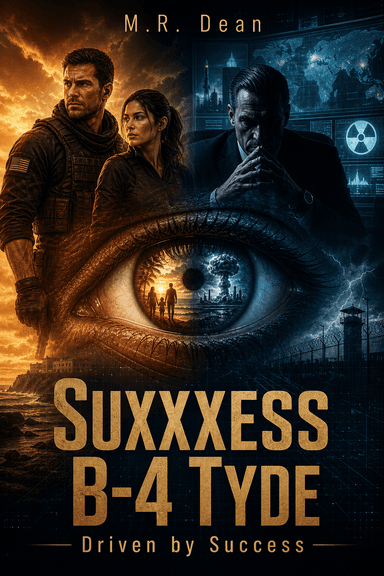
M.R. Dean's debut operates in the same emotional register as the shows above. Not in setting — the book moves from a federal prison in South Dakota to Russellville, Arkansas, to Fort Lauderdale, to a cruise ship in international waters — but in the fundamental structure of its tension.
Perry Wade, the retired super-agent protagonist who goes by "Success," is not in pristine operational condition. He's on medical leave. He's fighting alcoholism. He has a twenty-year-old emotional wound — his childhood love, Veronica "Vvee" Valdez — that has never healed, in part because Vvee is now a federal agent herself, and their relationship exists in the complicated space between their shared history and the professional structure that now surrounds them both.
"I have a twenty-year-old heart problem that I can't seem to fix." — Ch. 58
That line could be in a Power season finale. It's that specific kind of damage — the kind that isn't healed by competence, by mission success, by surviving what should have killed you. Perry carries it through every operation.
And the operation in front of him is genuinely enormous. Vick Tyde — the genius criminal mastermind running a weapons-acquisition network from inside a maximum-security federal prison — is not a plot device. He's a fully realized threat with infrastructure, a spouse handling external logistics, and lieutenants inside and outside the institution. When the Secretary of Defense tells you it could be the start of World War III, it's not hyperbole.
"If Tyde does manage to get out and get ahold of the materials he needs, it could be the start of World War III." — Secretary of Defense, Ch. 59
The Power comparison is in the personal stakes. The Snowfall comparison is in the scope of what's actually happening in the world the book builds. The Wire comparison is in the operational intelligence on both sides — this is not a story where the villain is stupid. Tyde is running circles around institutional response, the same way Marlo was invisible to systems designed to catch noisier criminals.
And the book closes the way Power seasons close — not with resolution, but with escalation.
"Things just got worse." — closing line, Ch. 60
Where to Start if This Is Your First Thriller
If Suxxxess b-4 Tyde is your entry point into thriller fiction, here's how to build from it:
Start with M.R. Dean's debut. Read it for the operational plot — the prison network, the cruise-ship undercover operation, the weapons acquisition chain — but also for Perry. For what he's carrying. For what it costs him to come back out of hiding for this.
Then, if you want to stay in the elite-operative lane, Vince Flynn's American Assassin gives you Mitch Rapp's origin — brutal, competent, mission-focused. That's the tradition Dean is writing in and departing from simultaneously.
If you want to go deeper on the institutional critique, The Power of the Dog by Don Winslow does for the drug war what The Wire did for Baltimore — documenting the machinery at every level, in novelistic form, over hundreds of pages.
If you want something that matches Power's emotional register — the personal destruction wrapped inside the plot mechanics — Walter Mosley's Easy Rawlins novels are worth your time. Different era, different genre technically, but the same understanding of what it costs a Black man to navigate systems designed to contain him.
Suxxxess b-4 Tyde sits at the intersection of all of these. It's not copying any of them. It's a debut novel by a South Florida writer who has built something specific: a government thriller with the emotional DNA of prestige crime television.
That combination is rare enough to be worth finding.
Suxxxess b-4 Tyde: Driven by Success by M.R. Dean is available now.
What Suxxxess b-4 Tyde Shares With Each Show
| Show | Core storytelling standard | How the book matches it |
|---|---|---|
| Power | Internal contradiction drives every conflict; endings escalate, not resolve | Perry's split between who he was and what's left of him; the book closes "Things just got worse." (Ch. 60) |
| Snowfall | Stakes are communal; the plot carries a structural argument about real systems | A weapons chain reaching from a federal prison to international waters; the World War III threshold named out loud |
| The Wire | Institutional texture; villains with real operational intelligence | Vick Tyde runs circles around the institutional response from inside a federal prison cell — invisible to systems built to catch noisier criminals |