You've read all the Mitch Rapp novels, possibly in order, possibly not — it doesn't entirely matter because what you're reading them for is consistent across every book in the series. The competence. The mission clarity. The controlled fury of a man who has been forged by loss into something the government deploys when every other option has failed.
Vince Flynn built something that endures because he understood the fantasy precisely: you don't just want to watch a capable man complete a difficult mission. You want to inhabit the specific kind of certainty that Rapp carries — the one that says I know exactly what needs to be done, I know I'm the one to do it, and I'm prepared to pay whatever it costs. That certainty, grounded in Rapp's origin story (the Lockerbie bombing, the loss of Libby Vasquez, the years of training that followed), is what made Flynn's series the standard for American political thrillers.
Flynn died in 2013. Kyle Mills has continued the series capably. But the question for readers who've exhausted the Rapp catalogue — or who want something in the same octave with a different tonality — is where to go next.
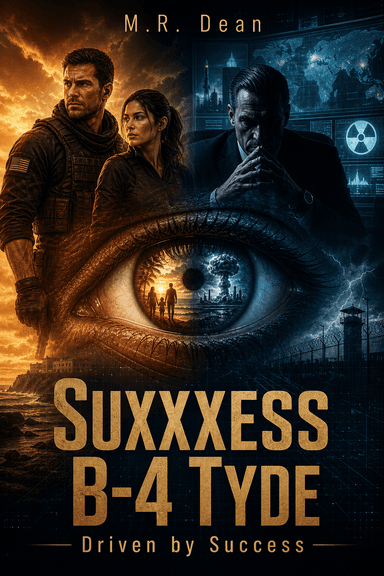
M.R. Dean's debut, Suxxxess b-4 Tyde: Driven by Success, is the answer. Not because it copies the Rapp template — it doesn't — but because it works from the same structural premise and builds something distinctly its own on top of it.
What Vince Flynn Built and Why It Still Works
Flynn's genius was specificity. Rapp is not a generic superspy. He's a specific man, with specific damage, working within a specific institutional framework — the CIA's Counterterrorism Center, his mentor Stan Hurley, his handler Irene Kennedy — and the books succeed because that specificity grounds even the most operationally elaborate plots.
Flynn also understood pacing as a moral argument. The books move fast because the threats are real and time is the variable the antagonists are always trying to exploit. Every chapter of delay is a chapter where someone Rapp is responsible for protecting is at greater risk. That structure — where speed is tied to stakes rather than just style — is harder to execute than it looks, and Flynn executes it consistently.
The read-alike problem most Rapp fans encounter is that other spy-thriller series tend to offer one of Flynn's qualities without the whole package. Lots of competent protagonists. Fewer with genuine emotional backstory. Lots of geopolitical stakes. Fewer with the personal thread that makes you care about the operator, not just the outcome.
The Mitch Rapp Formula: Competence, Rage, Mission
Strip the Rapp series to its essential structure and you get three elements working together:
Competence — Rapp is demonstrably better at his job than almost everyone around him. Not in an unbelievable, superhuman way, but in the specific way of someone who has trained longer, prepared more thoroughly, and developed instincts through actual experience rather than theory. He reads rooms, reads people, and reads situations faster than his enemies expect.
Rage — Rapp's competence is powered by something that hasn't gone cold. The loss that created him isn't resolved — it's redirected. American Assassin works as well as it does because Flynn doesn't let Rapp become purely professional. The anger is always there, barely managed, available as fuel when the mission requires it.
Mission — Rapp operates within institutional structure — with all the friction that creates — but his primary allegiance is to outcome. He'll navigate around bureaucratic obstacles, defy protocol, and accept personal risk that his handlers would forbid if they knew about it, because the mission matters more than any of the surrounding procedural apparatus.
That combination is the formula. And it's what M.R. Dean replicates with Perry Wade — then extends in directions Flynn never went.
Where Perry Wade Departs From the Template
Perry Wade is a retired super-agent. He's not between missions. He's on medical leave, fighting alcoholism, and emotionally unmoored in ways that Rapp — despite his damage — rarely is. Rapp's grief is focused. It made him sharper. Perry's grief is diffuse. It's spreading into every part of his life, including his capacity to function.
"I hope God does have something big planned because what I'm up against feels like Armageddon." — Ch. 58
That line doesn't sound like Mitch Rapp. It sounds like someone who isn't sure he can do this anymore — and has to do it anyway, because Vick Tyde is inside a federal prison building a network that the Secretary of Defense describes as a potential World War III scenario, and Perry is the government's best available option.
The distinction matters. Rapp at his lowest moments is still operating near his ceiling. Perry Wade comes back out of hiding operating below his floor. The gap between where he is and what the mission requires is wider — which means the stakes for the reader are different. You're not asking "will Rapp succeed?" You're asking "can Perry hold himself together long enough to succeed?" Those are emotionally different questions.
The Cultural Specificity That Changes Everything
Mitch Rapp is a white American from a specific class and institutional background. That's not a criticism — it's a structural fact that shapes how the books read. His relationship to the American government is one of qualified allegiance: he serves it, he sometimes resents it, but he never doubts that it is fundamentally his government, that his mission is its mission, that his success is its success.
Perry Wade is a Black American super-agent. That single fact adds a layer of cultural complexity that the Rapp books don't carry and don't attempt to carry — not because Flynn was incapable, but because it wasn't his story to tell.
What M.R. Dean has that Flynn didn't is the ability to write from the inside of that specific experience: what it means to be the best at something the country needs, while knowing that the country's relationship to people who look like you is not simple. Perry's nickname — "Success" — is not incidental. It's the name he earned, the identity he built, and the identity he's now fighting to inhabit again after years of decline.
The settings carry this specificity too. Russellville, Arkansas — where Perry grew up — is not Langley, Virginia. It's a specific place with a specific history, and the fact that Perry comes from there rather than from the institutional pipeline that produces most fictional American operatives is one of the things that makes him feel real rather than archetypal.
The Love Story Rapp Never Got
Rapp lost Libby Vasquez at Lockerbie, and that loss shaped everything that followed. Flynn handled it with appropriate weight, but the operative structure of the series meant that Rapp's subsequent relationships were always secondary to mission. The love story, such as it exists in the Rapp books, is resolved early and exists primarily as backstory.
Perry Wade's love story is live. It's present-tense. It's unresolved.
Veronica "Vvee" Valdez is Perry's childhood sweetheart from Russellville. She's also now a federal agent — which means she's not simply the emotional anchor in Perry's personal life, she's a professional presence in the world he operates in. The relationship between them is not clean. It hasn't been resolved by time or by profession. Perry is still carrying it.
"I have a twenty-year-old heart problem that I can't seem to fix." — Ch. 58
And then the mission puts her in direct danger. Tyde's brother Sid kidnaps Vvee. The personal and the operational collapse into the same crisis. Perry isn't just trying to stop a global weapons acquisition network. He's trying to get the woman he's loved since childhood out of the hands of someone who took her specifically to use her against him.
"You were always somebody. You assisted me in saving the world." — Vvee to Perry
That line lands differently because of everything that's come before it. In a Rapp novel, the stakes are geopolitical. In Suxxxess b-4 Tyde, the stakes are geopolitical and personal at the same time, and Dean never lets you forget it.
Why Debut Novels in This Genre Deserve More Attention
The thriller genre has a discovery problem. The bestseller lists are dominated by established franchise names — Rapp, Scot Harvath, Jack Ryan, Reacher — and debut novels that don't arrive with substantial pre-existing platform tend to get lost in the noise regardless of their quality.
This is the reader's loss, not just the author's. The franchise novels are good. The best of them are very good. But they're also constrained by continuity, by reader expectations established over decades, by the weight of series mythology. They can't take the structural risks that a debut novel can take — because the debut novelist doesn't owe the reader anything yet.
M.R. Dean owes Mitch Rapp fans nothing. He built something for a reader who wants elite-operative competence, real stakes, and a protagonist whose personal life is not safely quarantined from his professional one. He built a villain — Vick Tyde — who is smart enough that stopping him requires the best available asset even when that asset is compromised. He built a love story that functions as structural jeopardy, not decoration.
The book closes on a line that is the opposite of franchise resolution:
"Things just got worse." — Ch. 60
That's not a franchise protecting its character. That's a novelist telling you the story is real, and real stories don't resolve because a chapter ends.
How to Build a Read-Alike List Starting With Suxxxess b-4 Tyde
If Suxxxess b-4 Tyde is your entry point into this lane, or if you're building a rotation after finishing the Rapp catalogue, here's how the architecture looks:
Foundation: American Assassin by Vince Flynn — the origin, the template, the standard. If you haven't read it, start there and work forward.
Cultural depth: Suxxxess b-4 Tyde by M.R. Dean — same operational register as Rapp, with the cultural specificity and personal damage that Flynn's series doesn't access.
Institutional critique: The Watchman by Robert Crais — Joe Pike as a study in what elite capability looks like when stripped of institutional affiliation entirely.
Global scope: The Spy by Daniel Silva — Gabriel Allon as the European counterpart to Rapp, with more emphasis on history and identity than on pure operational mechanics.
Street-level realism: Anything by Don Winslow — The Cartel in particular — for when you want the same stakes but from inside the criminal organization rather than the government response to it.
Suxxxess b-4 Tyde sits at the center of that list: it offers what Rapp gives you, adds what Rapp doesn't, and leaves a sequel hook that tells you M.R. Dean is building something. Books 2 and 3 of the trilogy are expected within the year. Get current now.
Suxxxess b-4 Tyde: Driven by Success by M.R. Dean is available now on Amazon.
Mitch Rapp vs. Perry Wade
| Element | Mitch Rapp (Vince Flynn) | Perry Wade (M.R. Dean) |
|---|---|---|
| Operational status | Active, near-ceiling even at his lowest | Retired, on medical leave, fighting alcoholism |
| Damage type | Focused grief from origin backstory (Lockerbie, Libby Vasquez) | Diffuse, spreading — a 20-year wound and alcohol dependency |
| Love story | Resolved early; functions as backstory | Live, present-tense, unresolved — Vvee is also a federal agent on the case |
| Cultural identity | White American; allegiance to government uncomplicated | Black American; carries the complexity of that relationship to institutions |
| Home base | Institutional pipeline (CIA, Langley) | Russellville, Arkansas — outside the standard operative origin |
| Closing note | Franchise continuity | "Things just got worse." (Ch. 60) — no resolution guaranteed |