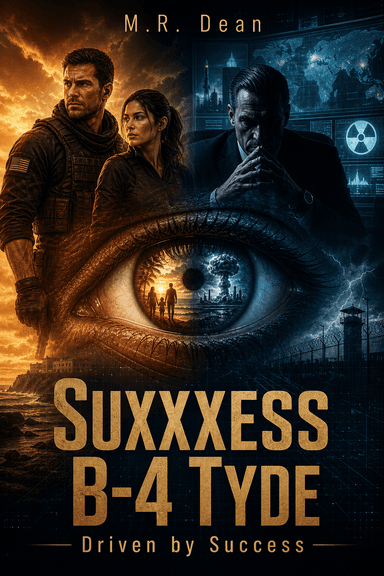
The Math: 419 Pages, 60 Chapters, 7 Pages Average
Run the numbers and the structure of Suxxxess b-4 Tyde becomes immediately clear. Four hundred and nineteen pages divided across sixty chapters gives you an average chapter length of just under seven pages. Some will be longer, some considerably shorter. But the governing logic is: chapters are short. Chapters end before the reader is ready.
That's a choice. It's not the default for the genre. The literary thriller tends toward longer chapters — room to develop atmosphere, internal monologue, the slow build of dread. Even commercial thriller writers who understand pacing often work in the ten-to-fifteen-page range.
Seven pages is closer to television. It's the scene, not the act. It's the unit of action that ends on something — a revelation, a threat, a shift in the power dynamic between characters — and then cuts.
Understanding this structural choice is the key to understanding how the novel moves.
What Short Chapters Do for the Reader
Short chapters do several things simultaneously, all of them beneficial in genre fiction.
First, they accelerate subjective reading time. There is a well-documented psychological effect where frequent chapter breaks make readers feel they are moving faster through a book than they actually are. Each chapter completion is a small satisfaction — a micro-resolution of the tension that chapter built. The reader finishes a chapter, feels the pull of the next one, and continues. James Patterson built his career on a version of this; many thriller readers don't even consciously register the structural mechanism, they just notice that the book feels fast.
Second, short chapters force authorial discipline. You cannot write a seven-page chapter that wanders. There's no room for scenes that exist purely for texture, for paragraphs that develop atmosphere without advancing either plot or character. Every element has to earn its presence. This is harder to execute than it sounds — padding is easy, compression is craft.
Third, and most importantly for a thriller: short chapters create sustained suspense through strategic incompleteness. A chapter that ends before the reader has full information — about what a character will do, about whether the operation succeeded, about whether the threat has been neutralized — pulls the reader into the next chapter involuntarily. They need to know. The chapter ending withholds the resolution just long enough to make the turn of the page feel necessary.
Dialogue as Propulsion: The Television Influence
Suxxxess b-4 Tyde is described consistently as dialogue-dominant. This is another structural choice with specific effects.
In prose fiction, dialogue is the fastest mode. It moves through time more quickly than description or internal monologue. It requires the reader to do interpretive work — to read tone, subtext, power dynamics from the words characters say and don't say — which creates a kind of active reading engagement that passive description can't replicate. And in a thriller, dialogue carries information efficiently: characters tell each other things, argue about things, threaten each other — and all of that advances the plot while revealing character simultaneously.
The television influence Dean has absorbed — and the shows in this genre (The Wire, Power, Snowfall) are all notably dialogue-dense — is audible in how the scenes are built. These shows don't explain their characters through voiceover or internal reflection. They reveal them through what they say, how they say it, and who they choose to say it to.
"Welcome to the regime, Cali." (Vick Tyde, Ch. 49)
That line is three words and a name. It tells you the speaker's worldview (he sees himself as a regime, not a criminal operation), his relationship to power (you join his world, he doesn't join yours), and his recruitment style (the naming of the recruit signals belonging). Three words. Every word doing structural work.
That's television dialogue applied to prose fiction. It doesn't waste syllables.
Scene vs. Summary: When to Trust the Reader
One of the fundamental craft decisions in any novel is when to dramatize a moment in scene and when to summarize it. Scene is slower, richer, more immediate — it puts the reader inside the experience in real time. Summary is faster, more efficient — it covers ground without dramatizing every step.
Bad pacing usually comes from wrong distribution of these two modes. Scenes that should be summarized get dramatized in full detail, slowing the narrative during moments that don't warrant the investment. Moments that should be scenes get summarized, leaving the reader at a distance from the events that matter most.
In a seven-page-average chapter structure, the writer has to make this call constantly and correctly. The scenes that get dramatized in Suxxxess b-4 Tyde are the high-stakes moments: confrontations, reveals, the scenes that shift who has power and who doesn't. The transitions — travel, time passing, events that move the plot but don't require the reader's full attention — get handled efficiently.
This is a form of trust. It trusts the reader to fill in what doesn't need to be shown. It trusts the reader to understand that a narrative cut between one location and another doesn't require a travel sequence.
Readers in this genre are experienced. They have read enough thrillers to know the conventions. Trusting that literacy is not laziness — it's appropriate calibration.
The Last Line of Every Chapter
In a short-chapter novel, the last line of every chapter carries disproportionate weight. It's the hinge. It's what either closes a scene with satisfaction or pries it open with a question that demands the next chapter.
"Things just got worse." (closing line, Ch. 60)
That's the last line of the novel. It closes a book that has been building toward resolution — the operation, the threat, the relationship between Perry and Vvee — with a statement that refuses resolution. The reader who finishes that line has been told, in three words, that whatever came before is not the end of the story. It's an opening.
For a debut novelist planning a trilogy, this is technically precise. It creates the pull toward Book 2 without requiring an explicit cliffhanger — no character in danger, no unresolved plot emergency, just a tonal statement that more is coming and it will be harder than what came before.
What Suxxxess b-4 Tyde Does Structurally That Most Debuts Don't
Most debut novels are structurally conservative. Writers working in genre for the first time default to longer chapters, more interior monologue, more scene-setting, more explicit description of character psychology — all the scaffolding that comes from uncertainty about whether the reader is following.
Suxxxess b-4 Tyde doesn't scaffold. It trusts the reader immediately, builds short and fast from the first chapter, and sustains that pace across all sixty. This is harder to do than the more cautious structural approach, and when it works — as it does here — the result is a reading experience that feels propulsive in a way that literary confidence creates and nervousness never can.
The seven-page chapter average is not an accident. It is the architectural decision that determines the energy of the entire novel. Dean made that call, held it across 419 pages, and delivered a debut that reads like it was written by someone who already knew exactly what kind of book they were building.
That's the craft. Learn from it.
Pacing Techniques in Suxxxess b-4 Tyde
| Technique | What it is | Effect on the reader |
|---|---|---|
| Short chapters | 60 chapters across 419 pages; scenes, not acts | Accelerates reading time; each chapter is a micro-resolution that pulls to the next |
| Strategic last lines | Endings that withhold resolution or open a question | Involuntary page-turns; Ch. 60 refuses resolution and sets up the trilogy |
| Dialogue dominance | Scenes built on what characters say, not interior monologue | The fastest mode in prose; makes the reader work on tone and subtext |
| Scene vs. summary | High-stakes moments dramatized; transitions summarized | Keeps the energy where it matters and trusts the reader's genre literacy |
Buy on Amazon — or read Chapter 1 free at /the-book#chapter-1.